“Your home should welcome you with smarter access and dependable protection.”
What if your front door could do more than simply lock and unlock? Imagine being at home with your hands full, letting a family member enter without handing over a spare key, or checking whether your door is secure while you are away. These everyday situations show how digital access technology can change the way people manage their homes. Smart locks offer alternative ways to enter, control permissions, and manage certain functions, depending on the model. For homeowners exploring Smart Locks in Sharjah, understanding these features can help them decide whether a smart locking system suits their property, lifestyle, and security requirements. In this blog, we are going to learn why you need smart locks in your home.
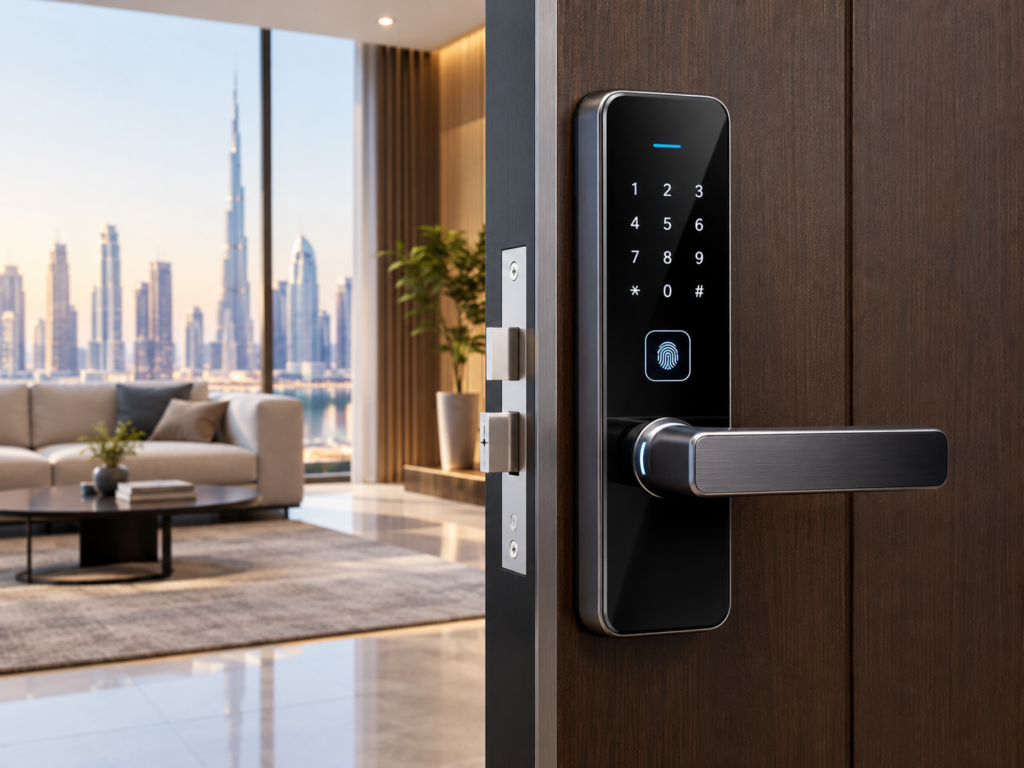
A home’s security begins at its entrance, making the door lock an important part of everyday protection. Traditional locks rely mainly on physical keys, while smart locks can offer additional ways to manage entry and control access. Depending on the model, these systems can combine digital authentication, user permissions, automatic locking, and remote access features. For homeowners considering Smart Locks in Sharjah, understanding these functions helps them decide how smart locking technology can support their daily routines and property security.
|
Everyday Situation
|
Smart Lock Feature
|
Practical Advantage
|
|---|---|---|
|
Keys are frequently misplaced
|
PIN or fingerprint access
|
Provides an alternative to carrying a physical key
|
|
Family members arrive at different times
|
Multiple user credentials
|
Allows authorised people to use their own access methods
|
|
Guests need temporary entry
|
Temporary access codes, where supported
|
Makes it possible to grant limited access
|
|
You want to check the door remotely
|
App-based status monitoring on compatible models
|
Helps you review the reported lock status while away
|
|
You often forget to lock the door
|
Automatic locking on compatible models
|
Can lock the door after a configured period or event
|
|
Battery power becomes low
|
Battery warnings and backup entry options
|
Gives you an opportunity to respond before power runs out
|
Traditional keys have been used by households for generations but can be a problem if there are several members of the family who have different schedules. They can be lost or misplaced, duplicated or forgotten, and can be an added responsibility when sharing with temporary guests. Smart locks offer alternative access points which can ease these problems and provide authorised users with greater flexibility.
The functions differ depending on the product, so it is important to verify what the product offers before investing in a smart lock.
Minor annoyances at the front door can quickly add up and become a nuisance. You might be in a hurry to find the keys in your purse, or when you’re in the dark, you may have a few copies. Smart locks provide multiple methods of access, which can help to streamline some of these scenarios.
The appropriate approach will depend on who will be using the door and their familiarity with the technology. One type of access might not be enough for a household. One type of access for everyone does not necessarily work for a household.
A single plan is a rarity in a household. There will be times when parents need to leave early to go to work, children may come back from school at different times, and other authorised occupants may need access throughout the day. Multiple users can be provided with different credentials, making access management easier with smart locks.
This can also be used to eliminate the necessity of sharing a single PIN with all those who use the entrance. If the lock can be used for separate user access, homeowners can control who enters the home more effectively and change credentials when household changes occur.
Excessive access is sometimes required by visitors, maintenance personnel, and others with permission from the homeowner. A keys-on-a-keyboard approach is cumbersome, especially if traveling for a short period of time. Some smart locks have temporary PINs or programmed access times that give access for a specific time.
But not all models have temporary access capabilities. The rules of operation and expiration of these should be reviewed before using them as a means to grant access to guests.
|
Guest Access Requirement
|
Feature to Look For
|
|---|---|
|
A visitor needs one-time entry
|
A single-use code, if supported
|
|
A service professional needs access during a specific period
|
Scheduled or time-limited permissions
|
|
A guest visits regularly
|
A separate credential with suitable access limits
|
|
A visitor no longer needs entry
|
A method to disable or remove their credential
|
Some smart locks provide activity logs, alerts, or app status updates. The following functions can assist homeowners with determining if the lock is secured and with seeing the access events selected. This may be useful for individuals who are on the road a lot, or spend extended amounts of time outside the home.
It is important to know the range of use for these functions. The status report of a lock is not necessarily an affirmation that the whole entrance is physically secure, and the activity logs may not capture all of the individuals who use the doorway.
Smart locks must fit the physical door as well as meet the household’s access requirements. Compatibility can vary due to the thickness of the door, material, existing lock mechanism, handle arrangement, and space available. The lock that is not appropriate to the door will need to be altered or will fail to function properly when installed.
Smart locks are not all internet-dependent. Other models rely on a keypad or fingerprint reader, Bluetooth, WiFi, a hub, or a combination of these. Certain functions, particularly remote access, may require a stable network connection or additional equipment.
Knowing these differences will go a long way to avoid post-installation disappointment. If the design of the lock permits, it can be accessed locally during an internet outage even if it has an app-based control system.
“Better door access starts with choosing technology that fits your everyday life.”
Smart locks are digital devices that are mounted on a crucial entryway, but they don’t automatically make it secure. Avoidable risks can be caused by weak PINs, compromised accounts, outdated software, or poorly managed access permissions. It is important that the homeowner is aware of all the security features of their chosen model and sets them up appropriately.
A front door is more than just an entryway; it’s the intersection of home security, accessibility, and convenience. By eliminating the need for physical keys and offering authorised users numerous access options, smart locks can simplify daily entry. However, the best option is determined by your door’s compatibility, preferred unlocking technique, security concerns, and backup access requirements. Compare these useful features with product quality, warranty coverage, and installation assistance while looking into smart locks in Sharjah.
A smart lock is an electronic door-locking system that allows authorised entry through methods such as PIN codes, fingerprints, access cards, or compatible smartphones.
Some models support local access methods without internet connectivity. However, remote control and certain app-based features may require Wi-Fi, Bluetooth, or an additional hub.
Not every model fits every door. Check the door’s material, thickness, existing locking mechanism, and installation requirements before choosing a smart lock.
Many models provide low-battery warnings and an emergency access method. Depending on the design, this may include a backup key or an external emergency power option.
Compare access methods, door compatibility, security features, battery arrangements, backup entry options, warranty coverage, and installation support.